SEARCH
A Safe Place to Explore
Questions About Life and God
Questions About Life and God
SEARCH
By Marilyn Adamson
We all want to make it through life with success, some sense that we did it right.
So what about the major world religions? Is there anything in them that might give our lives greater depth and direction?
The following looks at the major world religions… Hinduism, New Age Spirituality, Buddhism, Islam, and Christianity.* There is a brief description of each, their view of God, and what a person can gain from that religion.
*Each of these religions has sects with differing beliefs. The description given here focuses on the core beliefs of each religion. Other major religions, such as Judaism, could be discussed, but for brevity, we have chosen these.
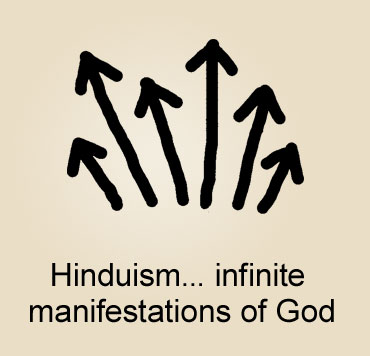 Most Hindus worship one Being of ultimate oneness (Brahman) through infinite representations of gods and goddesses. These various deities become incarnate within idols, temples, gurus, rivers, animals, etc.
Hindus believe their position in this present life was determined by their actions in a previous life. Hinduism therefore provides a possible explanation for suffering and evil in this life.
If a person’s behavior before was evil, they might justifiably experience tremendous hardships in this life. Pain, disease, poverty or a natural disaster is deserved by that person because of their own evil actions, usually from a previous lifetime.
A Hindu's goal is to become free from the law of karma…to be free from continuous reincarnations. Only the soul matters which will one day be free of the cycle of rebirths and be at rest.
Hinduism lets a person choose how to work toward spiritual perfection.
There are three possible ways to end this cycle of karma:
1. Be lovingly devoted to any of the Hindu deities;
2. Grow in knowledge through meditation of Brahman (oneness)…to realize that circumstances in life are not real, that selfhood is an illusion and only Brahman is real;
3. Be dedicated to various religious ceremonies and rites.
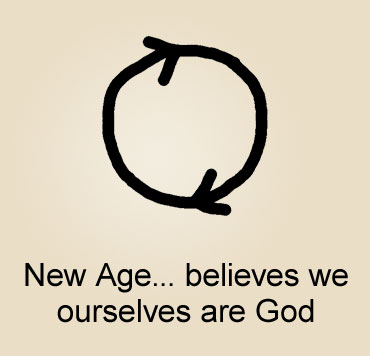 New Age Spirituality promotes the development of the person's own power or divinity.
When referring to deity, a follower of this type of spirituality is not talking about a transcendent, personal God who created the universe, but is referring to a higher consciousness within themselves.
A person pursuing spiritual development would see themselves as deity, the cosmos, the universe. In fact, everything that the person sees, hears, feels or imagines is to be considered divine.
Highly eclectic, New Age Spirituality is a collection of ancient spiritual traditions, taught by a vast array of speakers, books and seminars. It acknowledges many gods and goddesses, as in Hinduism.
The Earth is viewed as the source of all spirituality, and has its own intelligence, emotions and deity. But superseding all is self. Self is the originator, controller and power over all. There is no reality outside of what the person determines.
New Age teaches eastern mysticism and spiritual, metaphysical and psychic techniques, such as breathing exercises, chanting, drumming, meditating…to develop an altered consciousness and one's own divinity.
Anything negative a person experiences (failures, sadness, anger, selfishness, hurt) is considered an illusion.
Believing themselves to be completely sovereign over their life, nothing about their life is wrong, negative or painful.
Eventually, a person develops spiritually to the degree that there is no objective, external reality. A person, becoming a god, creates their own reality.
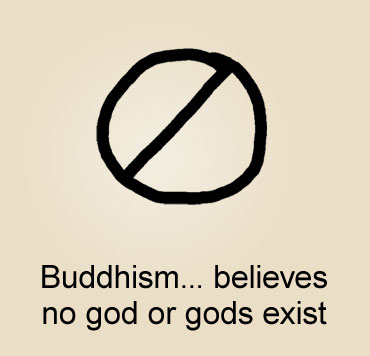 Buddhists do not worship any gods or God.
People outside of Buddhism often think that Buddhists worship the Buddha. However, the Buddha (Siddhartha Gautama) never claimed to be divine, but rather he is viewed by Buddhists as having attained what they are also striving to attain, which is spiritual enlightenment and, with it, freedom from the continuous cycle of life and death.
Most Buddhists believe a person has countless rebirths, which inevitably include suffering. A Buddhist seeks to end these rebirths.
Buddhists believe it is a person's cravings, aversion and delusion that cause these rebirths.
Therefore, the goal of a Buddhist is to purify one's heart and to let go of all yearnings toward sensual desires and the attachment to oneself.
Buddhists follow a list of religious principles and adhere to personal restraint, fasting and very dedicated meditation.
When a Buddhist meditates it’s not the same as praying or focusing on a god, it is more of a self-discipline. Through practiced meditation, a person may reach Nirvana – "the blowing out" of the flame of desire.
Buddhism provides something that is true of most major religions: disciplines, values and directives that a person may want to live by.
 Muslims believe there is the one almighty God, named Allah, who is infinitely superior to and transcendent from humankind.
Allah is viewed as the creator of the universe and the source of all good and all evil.
Everything that happens is Allah's will. He is a powerful and strict judge, who will be merciful toward followers depending on the sufficiency of their life's good works and religious devotion.
A follower's relationship with Allah is as a servant to Allah.
Though a Muslim honors several prophets, Muhammad is considered the last prophet, and his words and lifestyle are that person's authority.
To be a Muslim, one must follow five religious duties:
1. Repeat a creed about Allah and Muhammad;
2. Recite the same three prayers in Arabic five times a day, in a mosque when possible;
3. Give to the needy;
4. One month each year, fast from food, drink, sex and smoking from sunrise to sunset;
5. Pilgrimage once in one's lifetime to worship at a shrine in Mecca. At death, based on one's faithfulness to these duties, a Muslim hopes to enter paradise, not hell.
For many people, Islam matches their expectations about religion and deity. Islam teaches that there is one supreme deity, who is worshiped through good deeds and disciplined religious rituals.
After death, a person is rewarded or punished according to their religious devotion. Muslims believe that giving up one’s life for Allah is the only sure way of entering paradise.
 Christians believe in one God who eternally exists in a relationship with each other as Father, Son and Holy Spirit.
They describe him as one God, the creator of all that exists, and who wants us to experience his love now in this life.
Christians believe that Jesus Christ, the Son of God, left heaven and was born in human form near Jerusalem a little more than 2,000 years, now celebrated worldwide as Christmas.
The life and words of Jesus are contained in four complete biographies in the Bible, referred to as the gospels.
Unlike other religious leaders, Jesus did not identify himself as a prophet, but as fully God himself.
Throughout his life, crowds of thousands followed Jesus, as he taught and healed people of their diseases and disabilities.
As he taught, Jesus said he could provide guidance, peace, answer prayer, and give eternal life to all who will believe in him.
Prior to his death, Jesus clearly said he was going to bear the penalty for the sins of the entire world by dying on a cross, then physically come back to life, three days after his burial.
It was his resurrection from the dead that convinced so many that everything he said about himself was true, and that he could give people a more abundant life now, and eternal life as a free gift, to all who will believe in him.
To say that all religions are worshiping the same God would require Hinduism to give up their thousands of gods, New Age to stop believing they are god, and Buddhism to establish that there is a God.
There is a universal principle in nearly every religion to treat others the way we would want to be treated.
 We intrinsically know that we should be loving, less selfish, and live with integrity and care toward others.
We also know that we fail at this from time to time to some degree…some of us fail miserably.
This human weakness is often what leads to the creation of religions.
People create rules, rituals, and religious devotion to help us overcome the bad in us and accentuate what's good.
In honesty, probably any religious practice, in any religion, would likely make us better people simply because we're trying.
Practicing religion lets us know that we're making an effort. But over time, is it bringing us closer to God?
We might be yearning, honestly, is to know that God cares about us, accepts us, and will help us in this life. Right?
Among these religions, is there any effort on God's part, any movement toward us?
There is one example where we see God reaching out, actually coming to us, showing himself to us…that's in the person of his Son, Jesus Christ.
"For God so loved the world, that he gave his only Son, that whoever believes in him should not perish but have eternal life."1
Jesus not only revealed his thoughts, his heart, his ways to us, but he did so with a motivation of love.
Holding nothing back, Jesus allowed himself to be crucified, paying for our sin, and thereby eliminating the barrier that stands between us and God. He then rose from the dead.
 Jesus offers us completely forgiveness, a close relationship with him that can start now in this life, and continue in eternal life. This begins the moment we ask Jesus into our lives.
Jesus deeply wants us to know him. He said:
“If anyone thirsts, let him come to me to drink…out of his heart will flow rivers of living water.”2
“I am the light of the world, he who follows me will not walk in darkness, but will have the light of life.”3
“I came that you might have life and have it more abundantly.”4
“Come to me all who are weary and heavy laden, and I will give you rest.”5
This is God, the Creator of the universe, inviting us to freely come to him, to know him, to rely on him. He’s not pointing to a method of self-improvement like the Eight-Fold Path or the Five Pillars.
Instead, he invites us to experience a direct, personal relationship with him, not requiring a religious system in the middle, between us and God.
Our decision is not which religion to pursue, but how will we respond to God who invites us to know his love, to be guided by him, and be eternally cared for by him?
Jesus said, "Behold, I stand at the door and knock; if anyone hears my voice and opens the door, I will come in…"6
 If you have a desire to have Jesus come into your life, then he says if you ask, he will come in.
You can do that right now. If you need help in what to say to him, you're welcome to say something like this:
Jesus, I want to know you in a real way. I ask you to come into my life right now and establish a relationship with you. I look forward to getting to know you better and desire to have you guide me in this life. Thank you for paying for my sins on the cross. Forgive me now. Thank you for coming into my life right now, as you promised you would if I asked. Thank you for this relationship with you.
To learn more about Jesus and why you can trust him, please see Beyond Blind Faith.
| ► | I just asked Jesus into my life (some helpful information follows)... |
| ► | I may want to ask Jesus into my life, please explain this more fully... |
| ► | I have a question or comment... |
Footnotes: (1) John 3:16 (2) Matthew 11:28-30 (3) John 7:37-38 (4) John 8:12 (5) John 10:10 (6) Revelation 3:20
Other articles/videos you might be interested in…